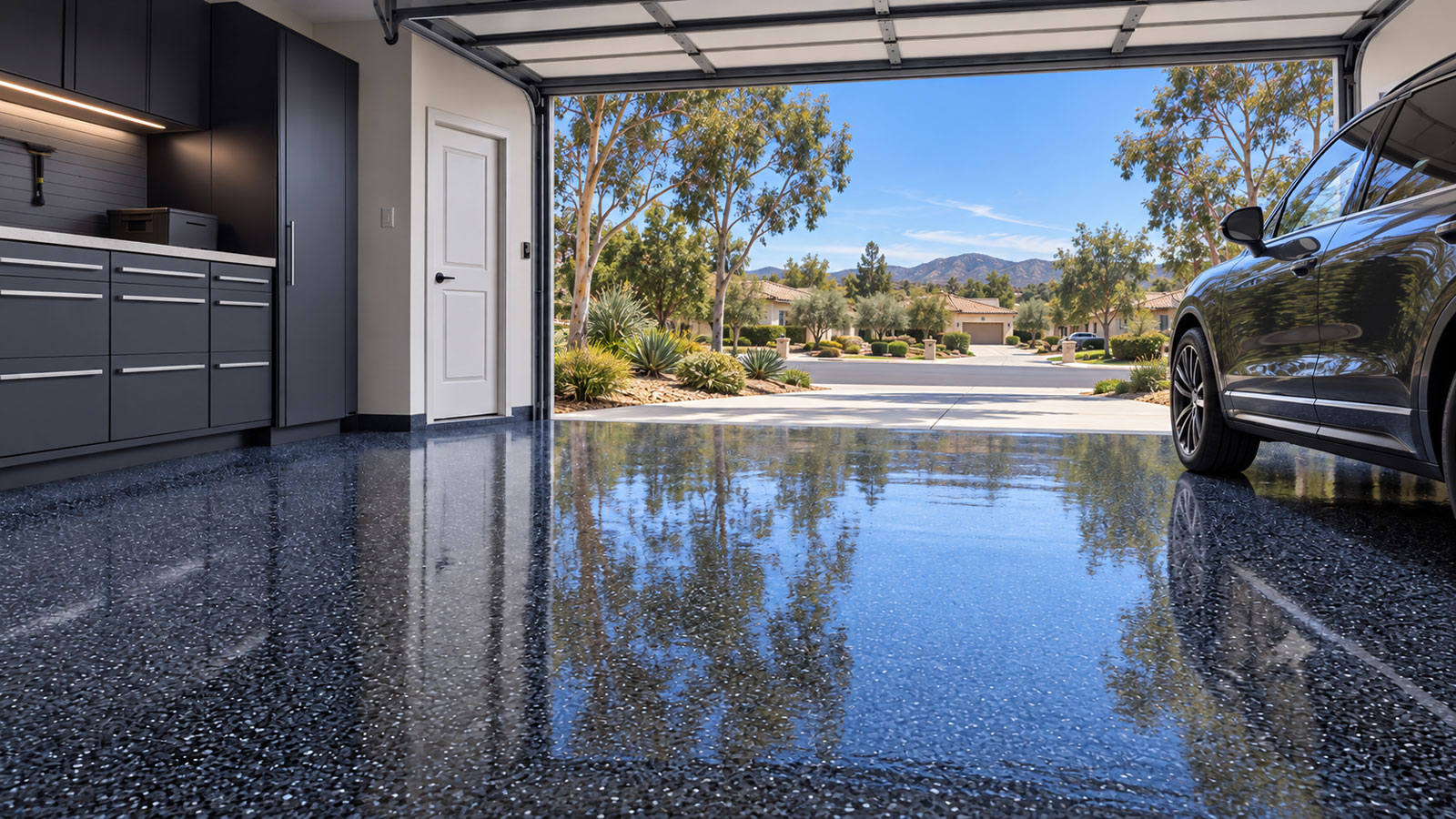
Garage Floor Coating in Santa Rosa, CA
Floor Coating Services in Santa Rosa, CA
Santa Rosa has an unusually wide range of garage-floor starting points. Many established neighborhoods have concrete that has been in service for decades, while Coffey Park and parts of Fountaingrove contain large concentrations of homes rebuilt after the 2017 fires. Two houses a few miles apart can therefore have completely different slab histories even when the garages look similar at first glance.
That difference matters because preparation should follow the concrete in front of you. An older garage may have paint, oil staining, patch compounds, anchor holes, or a previous DIY coating. A newer rebuild may have cleaner concrete but still need checks for curing compounds, sealers, cracks, and moisture before a coating system is installed.
Santa Rosa also has a dry-summer, wet-winter pattern and an extensive creek network. The practical questions are straightforward: what is on the slab, where does winter water move around the driveway and threshold, and how much direct afternoon sun reaches the garage opening? Those answers are more useful than assuming every Santa Rosa garage needs the same prep plan.
Local Market Insight
Santa Rosa combines mature mid-century neighborhoods with large post-2017 rebuild areas. Slab age can change sharply from one neighborhood to the next, so the estimate should verify the floor's actual history instead of inferring it from the city alone.
What Affects the Cost of Garage Floor Coating in Santa Rosa?
Garage floor coating in Santa Rosa typically runs $6–$12 per square foot, with a typical two-car garage around $3,000–$5,500. Final cost depends on floor size, existing coatings or sealers, crack and patch repair, edge work, moisture or drainage conditions, and the finish system you choose.
Older paint, sealer, or DIY coating removal
Established Santa Rosa garages may carry decades of floor treatments. Weak paint, unknown sealer, adhesive, or a failed coating usually has to be removed so the new system bonds to properly prepared concrete.
Rebuilt-neighborhood slab history
Coffey Park and Fountaingrove include many post-2017 rebuilds. A newer-looking slab can reduce some age-related repair, but curing compounds, surface treatments, cracks, and moisture still need to be checked rather than assumed away.
Crack, patch, and joint repair
Older slabs can contain stable cracks, previous patches, anchor holes, or chipped edges. The scope should distinguish cosmetic defects from areas that need repair before coating.
Winter drainage at the threshold
Santa Rosa receives most of its rain in the cool season. Driveway slope, gutters, irrigation, and nearby drainage paths matter when water regularly reaches the garage door or apron.
Sun exposure near open garage doors
Warm, dry summers can put strong sunlight on the first several feet of floor. UV-stable finish choices matter most where the coated surface is actually exposed.
Garage layout and finish choices
Steps, stem walls, storage alcoves, cabinets, multiple bays, decorative flake coverage, traction, and return-to-service timing all affect labor and material beyond simple square footage.
Call for a clear, project-specific estimate — or request one online.
Local Garage-Floor Conditions in Santa Rosa
A mature Santa Rosa garage can look clean and still hide adhesion problems. Old sealers may be nearly invisible, oil can penetrate the vehicle lanes, and earlier repairs can react differently to grinding. Mechanical preparation is what reveals whether the surface is ready for a new system.
In rebuilt neighborhoods, the questions shift rather than disappear. Newer concrete may have fewer decades of contamination, but it can still contain curing products, smooth power-troweled areas, shrinkage cracks, or repairs around utilities and walls. A post-fire rebuild should be inspected as a specific slab, not treated as automatically coating-ready.
Winter water is the other local variable worth separating from coating performance. If rain or irrigation repeatedly reaches the threshold, the source and path should be understood first. A coating can protect a prepared surface, but it should not be used to disguise an active drainage problem.
Older Santa Rosa and the Post-Fire Rebuilds Need Different Questions
Santa Rosa lost more than 3,000 residential units in the 2017 fires, with Coffey Park and Fountaingrove among the hardest-hit neighborhoods. The rebuilding that followed created a large pocket of comparatively recent residential construction inside a city with a much older housing base.
For garage floors, that means age-based assumptions are especially unreliable. One estimate may center on removing decades-old paint and repairs; another may center on profiling a newer slab and checking for curing products or early cracking.
The useful approach is to identify the slab's actual history before choosing the preparation method. That keeps the project scope tied to the floor rather than to the neighborhood's reputation.
Creeks and Winter Storms Put Attention on the Garage Threshold
Santa Rosa is crossed by Santa Rosa Creek and numerous tributaries, and the city continues to manage storm-drain and flood issues around those waterways. That does not mean every garage has a water problem, but it makes the driveway-to-garage transition worth checking during the rainy season.
Look for staining at the door line, water tracks after storms, low spots on the apron, irrigation overspray, and downspouts that discharge toward the driveway. Those clues help separate a surface-coating project from a drainage issue that needs its own solution.
Once water movement is understood, the coating can be specified around the garage's real use: vehicle traffic, storage, cleanup, traction, and the amount of sun that reaches the opening.
Questions to Answer Before Coating a Santa Rosa Garage
- Is the slab original, a later replacement, or part of a post-2017 rebuild?
- Is there old paint, sealer, adhesive, or a previous coating anywhere on the floor?
- Are cracks and patches stable, or are any areas deteriorating or moving?
- Does winter rain, irrigation, or a downspout send water toward the garage threshold?
- How far does direct afternoon sun reach into the garage when the door is open?
- What cabinets, steps, stem walls, appliances, or storage areas affect the work area?
Santa Rosa Garage Floor Coating FAQs
Are garage floors in Coffey Park and Fountaingrove usually newer than elsewhere in Santa Rosa?
Many homes in those neighborhoods were rebuilt after the 2017 fires, so newer slabs are common there. That can mean less decades-old contamination, but the concrete still needs normal checks for curing products, cracks, sealers, moisture, and surface profile before coating.
Does an older Santa Rosa home automatically need extensive concrete repair?
No. Older concrete can be an excellent coating surface when it is sound. The meaningful issues are existing coatings, contamination, cracks, patches, moisture, and how well the slab can be mechanically prepared.
Should winter water at the garage door be fixed before coating?
If water repeatedly enters or ponds at the threshold, its source should be understood first. Coating the slab does not correct driveway slope, runoff, gutter discharge, or a low garage entrance.
Does Santa Rosa's summer sun change the coating choice?
It can near an open garage door or on exposed apron areas. Where direct sun regularly reaches the finished surface, a UV-stable topcoat is a practical consideration; deeper interior areas may have much less exposure.
Santa Rosa Neighborhoods & Local Context
Phone Quote Line
Speak with a floor coating specialist about your project and get a realistic estimate range.
(707) 622-3555Typical Project Cost
$3,000–$5,500
Typical range for a two-car garage. Final pricing depends on floor size, concrete condition, prep work, coating type, and finish options.
Helpful Guides
Other Service Areas